I am working at a Veterans Affairs (VA) hospital this month and I’ve noticed approximately 47 things that could be more efficient. Here’s one: I wasted 8 days waiting for computer access despite filing the paperwork a month in advance. Another: Patients often linger in the hospital for days longer than needed because of issues with discharge planning. One more: Every morning I walk through metal detectors and then also open my backpack so that one of five stationed security guards can glance inside.
I’ve only been at the VA for 3 weeks, so I’m not sure exactly what would make these things more efficient. Maybe there aren’t enough staff to manage the credentialing process, given the complexity necessary for government security. The discharge delay is a common problem at most hospitals, since it depends on a complex system of insurance authorization and independent facility discretion. Perhaps we only need 3 security guards and not 5 at the entrance every morning. I’m not sure. I’d need more time to learn about the system and listen to people who are already working to improve things.
I am what the kids call a “minmaxer.” I love to minimize cost and maximize outcomes. I win board games by constantly calculating the resource to point value. I always calculate the price per pound at the grocery store. I like to walk to the other end of the subway platform before the train arrives so that I’m already at the correct exit when I arrive. Some people stop and smell the roses. I wait until the roses are at their peak.
So I am angry – no, furious about the blasphemous exercise of the efficiency principle by the federal government. Henry Ford made cars more efficiently by changing the way they were produced. Sometimes, this meant cars were made with fewer people, who could hopefully spend their time doing something else, but it also meant that cars were accessible to more people. We can debate the true merits of prioritizing efficiency, which I am often forced to do with my travel companions on subway platforms, but there is no debate about what efficiency means: making more with less.
This administration is just making less with less. The haphazardly created Department of Governmental Efficiency (DOGE) is not optimizing workflows, improving processes, or streamlining the provision of government services. They are simply finding things they don’t like and blowing them up. Imagine an episode of The Apprentice, but instead of challenging the contestants, they just blindfolded the host and had him randomly fire half of the crew. Then, in the second episode, they would frantically rehire all of the camera operators and production assistants who kept the show running.
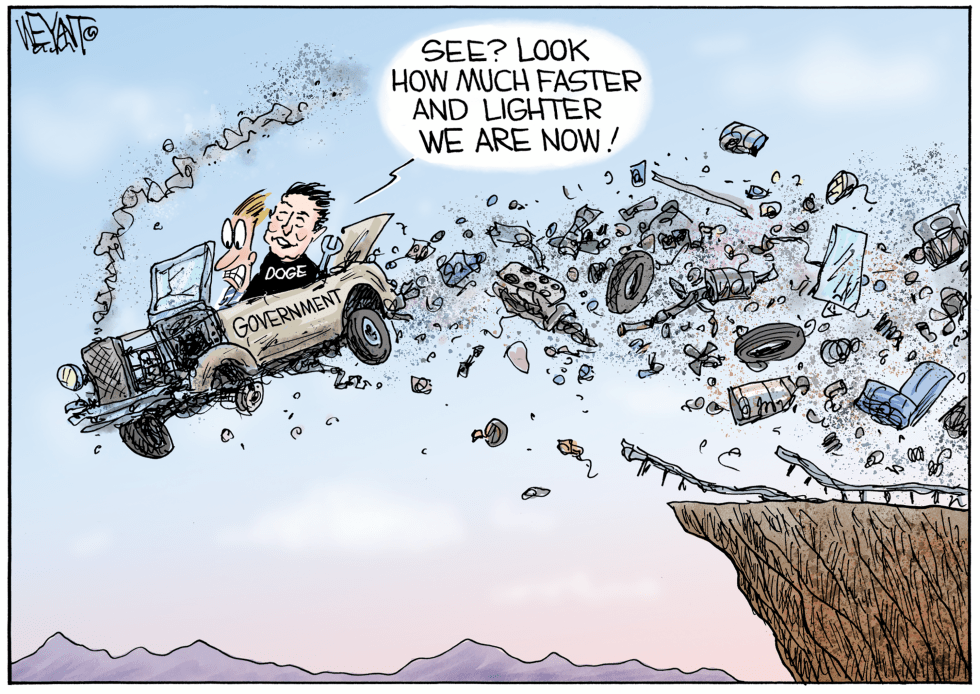
DOGE is doing less with less by making empty promises about the future to consolidate capital and power right now.
Cartoon credit: Christopher Weyant
This is not just bad TV. It is a mediocre metaphor for the practice of modern corporate efficiency. Gone are the days of corporate obligations to community, customers, and workers. The only responsibility corporations have now is to their shareholders, who have no other stake in the enterprise besides profit. Company leaders flit from gig to gig, making choices that maximize the short-term potential of the business, so that stocks can be sold and bought in the most advantageous way. Layoffs make the books look great for a few fiscal years until expertise is lost and quality declines. By then, the people in charge have collected their winnings and moved on to the next thing. Meanwhile, employees are out of a job, consumers are stuck with lousy options, and we all just have to accept that airplanes may fall apart midair.
This is weaponized efficiency. No one can disagree with doing more with less. But “more” is an ephemeral promise in the distant future and “less” is real, potentially irreparable damage, right now. While we’re all distracted, arguing about exactly how inefficient the government is, Elon is paying out more government contracts to SpaceX. This is not about doing more with less. It’s about money and power. It’s about doing much less for the many so that a few can have way more.

 Nobody asked me...
Again, a good analysis of what’s wrong with our system. We should be learning from other countries how good a health care system can be when it’s not operated on a profit model. But dismantling the present system will probably be impossible until a truly progressive government is installed.
LikeLike
Thank you for a gre
LikeLike