
No, I don’t think you’re dummies. In fact you’re probably the smart one. You probably didn’t waste over $200,000 on a medical degree. But you’re in luck! I did.
There is a ton of information floating around about coronavirus. A lot of it is about necessary public health measures or the political response. Some of it is about the virus itself. Most of it is moving human interest stories. Discussion about the details of the virus and the disease itself are largely being presented in inaccessible articles aimed at scientists, doctors, and statisticians. It’s no wonder most people are confused. Where do people go when they want to figure out if that newscaster or meme or Facebook post is telling the truth?
Well, I’m flattered that some people come to me. This time, somebody did ask me. My cousin sent me a Facebook post about why the coronavirus was so much more deadly than the flu. She asked me if it was accurate. I said yes and no. It was complicated. So here is my long and complicated response. I tried to break it up into several headings so you could skip the parts you already know or don’t care about. I’m going to avoid quoting the whole Facebook post here, since it’s long and not all of it is true. Instead, I’ll just try to answer all of the questions it brings up.
What is a virus?
A virus is just a collection of genetic data (DNA or RNA, see below) that can do nothing or wreak havoc, depending on the circumstances. The most important thing for you to know about viruses is that they are not “alive.” This is one of the main things that make them different from bacteria. The virus depends on the host to replicate. This means that in order for the virus to make more copies of itself, it needs to use the cells and machinery of the thing it has infected.
One example of a viral infection is the common cold. If you simplify everything a healthy body does, you can imagine an office worker at a desk scanning a stack of important papers so they can be used to do great things. This is like a cell in your body. There are millions of cells and millions of workers, all a little different. Now your healthy body comes down with a cold. You can imagine that a bunch of the office workers in your nose and throat and lungs suddenly had a bunch of random papers dumped on their desk. They have to just keep scanning papers, including these new garbage ones. It’s exhausting. Viruses suck.
What is a coronavirus?
There are many different types of viruses which scientists break up into classes largely based on what kind of genetic code they use, how they replicate, and what type of structure they have. Coronaviruses use RNA as their genetic code. Examples of diseases caused by coronaviruses include the common cold or SARS (severe acute respiratory syndrome).

The little spikes make it look like a crown. That’s why they call it “corona” virus. Corona means crown, not just light beer.
What is RNA?
You’ve probably heard about DNA before. DNA is the code our bodies use to pass along genetic information. There are four different molecules that repeat millions and millions of times. Like a giant chemical supercomputer. Their main job is to be translated into a different type of molecule chain called RNA, which is similar to DNA. There are a lot of reasons why this seemingly complicated process works pretty well for Earth’s creatures. The gist is that this RNA is then turned into proteins, which are the basic building blocks for not only your totally ripped post-gym biceps, but almost everything the body does or creates. So DNA turns into RNA and RNA turns into proteins. The DNA and RNA code is basically the same whether you’re a mushroom or a snail or a bacterium or a lady from New Jersey. The order of those millions of molecules is just a little different. To use the office worker analogy, all the documents we’re scanning are written with the same alphabet and sometimes the same language, whether we wrote the document or a virus did.
Where did this coronavirus come from?
The short answer is we don’t exactly know. It is a “novel virus” (see below) that we had never encountered before the end of 2019. The virus probably started in some animal and then eventually developed the ability to infect humans. This means that it mutated and was now able to use human cell machinery to make more copies of itself. Again, using our office worker analogy: before, the virus spoke gibberish, so no one paid any attention to it. But now it can speak English, so its junk paperwork is being put all over our desk and we have to keep scanning it. It is unclear from which animal or precisely when the virus “jumped” species.
What is a novel virus?
When we say novel virus, we mean a virus to which humans have yet to be exposed. This is important for one main reason: no one has any immunity.
What is immunity?
Immunity sometimes means you are completely safe from disease (or poison). It can also mean that you are partially safe from a disease. Our bodies have intricate and elaborate systems to defend against microscopic intruders. There are specific cells that float around your body and look for pieces of protein or genetic code or other molecules that do not come from your body. It would be like an auditor coming into your office once a day to look through all the papers you’ve scanned, with a keen eye for the ones that don’t belong. When they find one, they launch a cellular attack. This attack is the thing that often makes you feel sick when you have an infection. Part of the attack involves the creation of antibodies, which are special molecules designed to recognize these intruder molecules. It’s like adding the infection to your body’s Most Wanted list. The next time that virus or bacteria comes around, your antibodies are ready to tag them for destruction. If the infecting molecules look the same the second time around, your body’s response is swift and it’s like you never even have an infection. This is how vaccines work. They give your body a little bit of the infecting molecule so that you can start building resistance before a real infection comes around. It’s like hanging up Wanted posters all around your office.
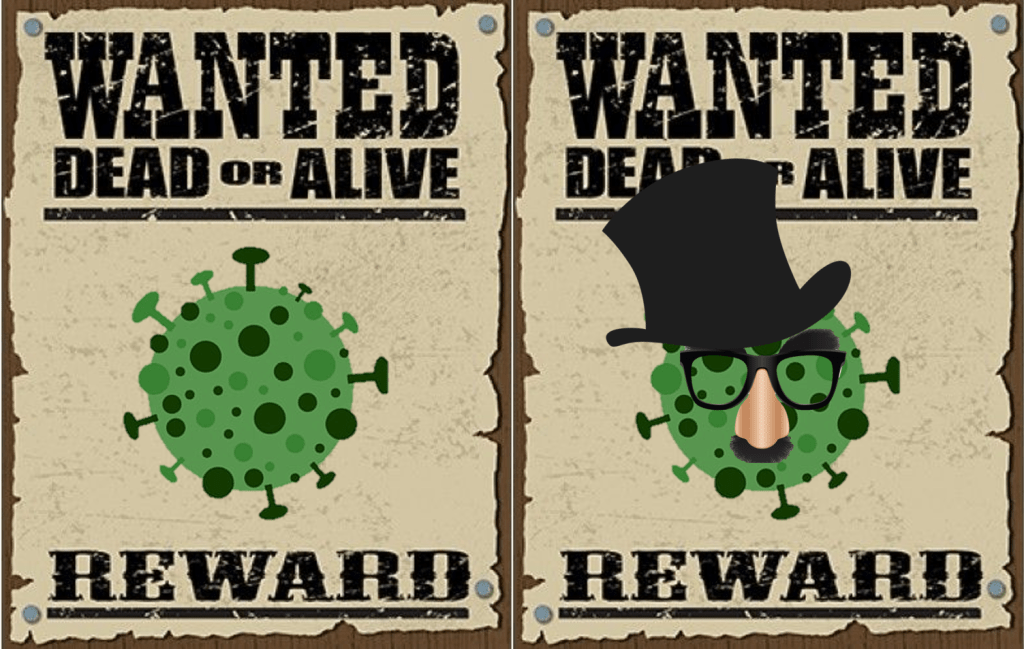
This is a cartoon representation of how your immune system works. It might make some immunologists cringe. But my immunology professor was fun.
However, if these infecting molecules look a little different the second time around, your body won’t respond as quickly. It’s like they put on a hat or some Groucho Marx glasses. You can still tell it’s them eventually, but not as quickly. This is what happens when viruses mutate. The classic example of this is the seasonal flu. The influenza virus mutates all the time. It’s still influenza, but its genetic code looks different every year, which means the virus molecules it makes in your body also look different every year. It puts on a hat and some Groucho Marx glasses. This is why we have to get a flu vaccine every year and why we can still sometimes catch the flu anyway. The important thing to remember is that even if you do get the flu, your body’s prior experience with pieces of the flu will help you fight it off. Because you still recognize some pieces of the virus, you can mobilize your immune system troops a little faster.
With a novel virus, no one has ever seen any of its pieces before. It’s the once in a decade serial murderer out on the loose.
How do viruses mutate?
In popular culture, mutation is often displayed as some sort of freak-accident-superhero-spiderman-crazy-ability-fluke. That’s not exactly true. Every single time any organism (mushroom, snail, bacterium, or lady from New Jersey) makes a copy of their genetic code, they make mistakes. Just like if you’re typing or writing a copy of something. Words get switched or mispelled, punctuation gets missed, or you make a typo. Or sometimes you spill coffee on the letter you’re writing. That’s a mutation. (The coffee example is closer to sun damage as a source of mutations, but that’s a different blog post.) These mutations are random and usually have little to no effect on the organism’s functioning. Sometimes they can be devastating (genetic diseases) or sometimes they can be useful (developing a mutation that allowed us to digest milk proteins). If they are useful or at least not harmful, the organism survives or thrives and the mutation is passed on.
Most complex organisms (the mushroom, the snail, and the lady from New Jersey but usually not the bacterium) have some process that helps detect and fix these errors, which keeps the mutation rate lower. Things like bacteria or especially viruses, have little to no editing infrastructure. They mutate all the time and nothing checks their work. Most of the mutations make the virus stop working. But that’s no big deal, because the viruses are replicating constantly and they have several brothers or cousins or great-nieces that can continue their infecting family legacy. Once in a while, though, the mutation is one of those freak-accident-superhero-spiderman-crazy-ability-flukes. All of a sudden, the virus can speak English, not gibberish, and can infect humans. Or all of a sudden, it learns how to wear a hat and buy Groucho Marx glasses. Either way, not great for humans. This is why our immune systems are constantly on alert.
There is no evidence that this virus mutates way more than other viruses. COVID-19 seems to be mutating quickly, but many viruses do this.
How is COVID-19 different from the flu?
They are both caused by viruses. COVID-19 is the name of the disease caused by the severe acute respiratory syndrome coronavirus 2 (SARS-CoV-2). The flu is the name of the disease caused by any of the many versions of the influenza virus. They are both infectious and contagious respiratory illnesses. They also have many of the same symptoms including cough and fever. COVID-19 can cause body aches or vomiting, but that seems to be more common with the flu. If you think you may have symptoms consistent with COVID-19, call your local health department hotline to speak with a health professional.
Is COVID-19 worse than influenza?
The short answer is yes. It is worse, on average, for you, individually, if you contract it. It is also much worse for our community than a typical flu season. Let me go into more detail…
Why is COVID-19 worse than the flu for me?
This virus is probably inherently a little worse than the flu, but this is exacerbated by the fact that no one’s immune system has seen it before. COVID-19 also affects the heart and lungs in a more severe way than the influenza virus does. They are different types of viruses after all. People seem to be requiring higher levels of care in order to survive. About 80% of people will not need expert medical attention, they can stay home and weather it like a bad version of the seasonal flu. But 20% of people who contract COVID-19 will need to be hospitalized and 25% of those people will require intensive care like a ventilator or something even more serious. By the numbers, COVID-19 is at least twice as deadly as the flu, though up to 5 times as deadly for people over 60 years old. We track this data with a number called the case fatality rate (see below).
A lot of people have been calling this a disease of the elderly. This is mostly because a higher percentage of elderly folks require more intensive medical care and a higher proportion of them eventually die from COVID-19. But young folks are not immune. And in fact, they seem to be a huge source of spread for the virus, as they may be infected and unaware. In South Korea, where there have been enormous rates of testing, over a quarter of their cases are found in people between 20 and 30 years of age. Furthermore, just because this disease is statistically less dangerous for young people than old people does not mean young people are invincible. If you’d like a harsh reminder, check out this article about two young health professionals in China or this one about the forty year old physician in an ICU in Seattle.
What is a case fatality rate?
Epidemiologists (public health people who specifically study the spread of disease) use a bunch of different measures to define how bad a disease is. We use a case fatality rate (CFR) during outbreaks like this because you do not need complete information to calculate it. The number will change over time as we learn more about what’s happening. To calculate the CFR, you take the number of people who have died and you divide it by the number of people who have been diagnosed with the disease. We then usually express this as a percentage: 5% of the people who contract the disease have died. Note that I used the past tense. This is a number that tells us what has happened or is happening, not exactly what will happen.
This number also changes constantly, as people die and as new people are testing positive. It also directly relates to the environment over time. If too many people get sick all at once, and we run out of hospital beds or ventilators or doctors, the case fatality rate will increase because more people will be dying of the disease. On the other hand, if we increase the denominator by testing more people, the case fatality rate usually decreases. This is because there are usually many more people who have the disease than we know about. When the outbreak is over, a final case fatality rate can be calculated with all of the available data.
What is the case fatality rate for COVID-19?
Remember, this number changes depending on the timing and place and environment. When the outbreak started in Seattle, there were three cases of COVID-19 and one death. At that time, the case fatality rate was 33% because 33% of the people who contracted COVID-19 died. But that can’t be right, you say. That seems way too high. You’re correct. There was not nearly enough data to provide an accurate estimate. Every day we have more data and can calculate new CFRs for different countries, different regions, and the world.
Right now in the US, the CFR is estimated at just under 2%. But this number isn’t correct either. Almost everyone in the US who has COVID-19 has not recovered yet, meaning we don’t know if they will live or die. This number is likely going to increase because of that. However, this number can also go down as more people are tested and found to be positive, increasing the denominator. And remember, the CFR is not just about the virus itself. It is mostly a reflection of how we react to it. It depends on how many people we are testing and how overwhelmed our health system becomes. Projected estimates of the final CFR for this outbreak of COVID-19 are between 2-3%. It is probably 2-3x higher for people over 60 years of age. However, the projected CFR is below 1% for countries that were prepared for this and flattened their curve (for example, South Korea and Singapore). On the other hand, the projected CFR for countries that were not prepared for this pandemic is closer to 5%. I don’t know which group the United States is in, but I would guess there are a lot of areas in the unprepared group.
Why is COVID-19 worse than the flu for everybody?
Well, if COVID-19 is worse than the flu for individuals, it’s also worse for everyone. But there’s more to this problem and pandemic. Above, I mentioned that approximately 20% of people who contract COVID-19 will need hospital care to survive the illness. That is way more than the seasonal flu. And more people will eventually contract COVID-19 than the seasonal flu because nobody’s immune system has seen it before. So we will have more people needing more hospital beds. And we don’t have them.
Several groups have been trying to estimate just how bad this hospital bed shortage will be, based on how fast or slow the virus will spread, and how well hospitals will be able to prepare for the growing throngs of people needing care. The outlook is not good. Even with the most conservative underestimations of the viral spread, many hospitals will have to clear out 25% of their hospital beds in order to treat COVID-19 patients.
This is the major danger. This is the reason that unprepared countries have a CFR up to five times that of prepared countries. This is why we must take it seriously. This is why we must make sacrifices and changes now (or last week) to ready the healthcare system and flatten the curve. Remember, it takes days to a week for the virus to reveal itself once infected. The things we are seeing now reflect the decisions we made 7-10 days ago.

What does “community spread” mean?
When COVID-19 first showed up in New Mexico last week, it was in someone who had recently traveled to NYC. They had presumably been infected there. Other people then contracted COVID-19, but after close contact with this individual. This is travel related spread. Eventually, someone will show up who has contracted COVID-19 and we won’t be able to link them back to someone else who had it from that initial group. This is community spread. It means that there are other unknown people that have COVID-19 and infected this person. It also means that those unknown people are infecting other people who are infecting other people. Community spread is not good. Places like NYC and Seattle have been seeing community spread for weeks now.
Do we have any treatments for COVID-19?
The short answer is no. There is no vaccine yet and there are no well-proven effective treatments. New data comes out every day and in serious circumstances, doctors are trying medications that might work. But, for the most part, all we can do to treat COVID-19 is to provide what we call “supportive care.” This means that we help your body fight the virus on its own using fluids, careful monitoring, and sometimes machines to help with breathing.
How do we know that social distancing works?
Social distancing works mathematically and it has worked historically. When I say mathematically, I mean statistically it makes sense. Check out this set of great interactive graphics from the Washington Post. It has also worked historically. The best anecdote is this story about the Spanish Flu pandemic of 1918.
Well, what should I do?
- Wash your hands. Don’t go out. Work from home. Even if you’re not sick.
- Check up on your friends. Your neighbors. Old folks. Sanitation workers. Health professionals. Or strangers. Help each other.
- Try to keep the information you read and spread accurate and useful. Panic and anger hurt. Honesty and camaraderie help.
- If you feel ill and think you might have symptoms of COVID-19, call your local health department hotline.
- Stop stealing masks! I have to wear one mask all day at work in the operating room because people made a bunch of ours disappear. I know you’re scared. So am I. Stay home and leave the masks for people like me, for when sick folks cough on us in the hospital. And if you did take masks, in a moment of panic, you can always give them back.
- Meditate. Keep exercising. Learn something new.

 Nobody asked me...
Thank you Ani!!💜
LikeLike
Because I knew you, I have been changed for good. ❤️
LikeLike
Thanks for the easy to understand and helpful information!
LikeLike
Your cousin John here again. Suppose I get the virus and am sick, but have recovered. Am I still a carrier? Can I go out and meet people, or help at a community center or whatever, without either getting it again or giving it to others? That might be a good topic to cover in your next blog, which I await with bated breath.
LikeLike
You are awesome…..
Just want to say I didn’t see the link to the Washington Post Graphic..if it’s the one with the moving balls it’s great and you should share it:)
Also didn’t see the link to the Spanish flu anecdote……I don’t want to miss anything! BTW, PBS had a great show on the 1918 epidemic on American Experience.
Love you!
LikeLike
The links are working for me, but I’ll post them here in case other people are having trouble:
“great interactive graphics” links to https://www.washingtonpost.com/graphics/2020/world/corona-simulator/
“this story” links to https://qz.com/1820233/what-past-pandemics-can-teach-us-about-responding-to-coronavirus/
❤️
LikeLike