Two weeks ago, I was talking all about how COVID-19 was just a bad version of the flu. We would all get it eventually, it would be fine, people should keep living their lives. I was wrong. I was in denial.
Then, I moved on to anger. I was angry that my family decided to postpone its once in a decade reunion because it was on a cruise ship. How silly, I thought. How hysterical. I rolled my eyes. I then tried bargaining. Well, fine, I thought. Maybe I couldn’t go on the cruise, but I wasn’t going to waste those expensive flights. When I was told by the hospital where I work that I could no longer travel to the east coast at all, I was sad. I live far away and don’t see my extended family very often. This was so unfair. How could this huge sacrifice help people? This was ridiculous.
But I started reading. And the articles inspired me to pull out my old epidemiology notes, relive my stint as a student of public health, remember that life before medical school. I was reminded about flattening the curve in order to reduce the burden on the health care system by decreasing how rapidly the virus spreads. I was reminded about how we did and did not handle the 1918 Flu pandemic, how everyone was mad at the mayor of St. Louis for canceling events, but his actions produced a case fatality rate one tenth that of Philadelphia, where they held their parade anyway. I spent a long time pouring over the data from the last two months, realizing this was worse than the flu and spreads faster, and that it was swiftly spreading out of our control. I reached acceptance. I had made it through my five stages of grief and realized that this virus was in fact a real global pandemic and that it had landed on our doorstep and that we were moving much too slowly.
I had moved much too slowly. Me. A physician. With a background in public health. Most doctors are not epidemiologists. In fact, we’re the exact opposite. Our commitment is to treat the patient in front of us. Not an amorphous hidden virus. It took me nearly two weeks to overcome my shock and grief and realize what needed to be done. Fourteen days. How long will it take other physicians, with all of our individualized medical expertise and no training in collective public health? How long will it take an ordinary citizen, trying to fight the fear mongering and misinformation? How long will it take our unprepared or willfully ignorant politicians?
Too long, unfortunately. We did not contain this virus. We are now trying to mitigate it. Remember the curve I mentioned above? It must be flattened at all costs. Italy waited too long to flatten their curve and now they’re running out of ICU beds and ventilators and deciding in the moment who receives treatment and who will die. We have three confirmed cases of COVID-19 where I live and work in New Mexico and the true number is certainly higher. Every other place that started with three cases saw exponential spread. Next week we will have 100 cases. Soon, thousands. We lose health care providers every day to quarantine and symptoms. Our already overextended health care system cannot handle anything other than a flat curve.
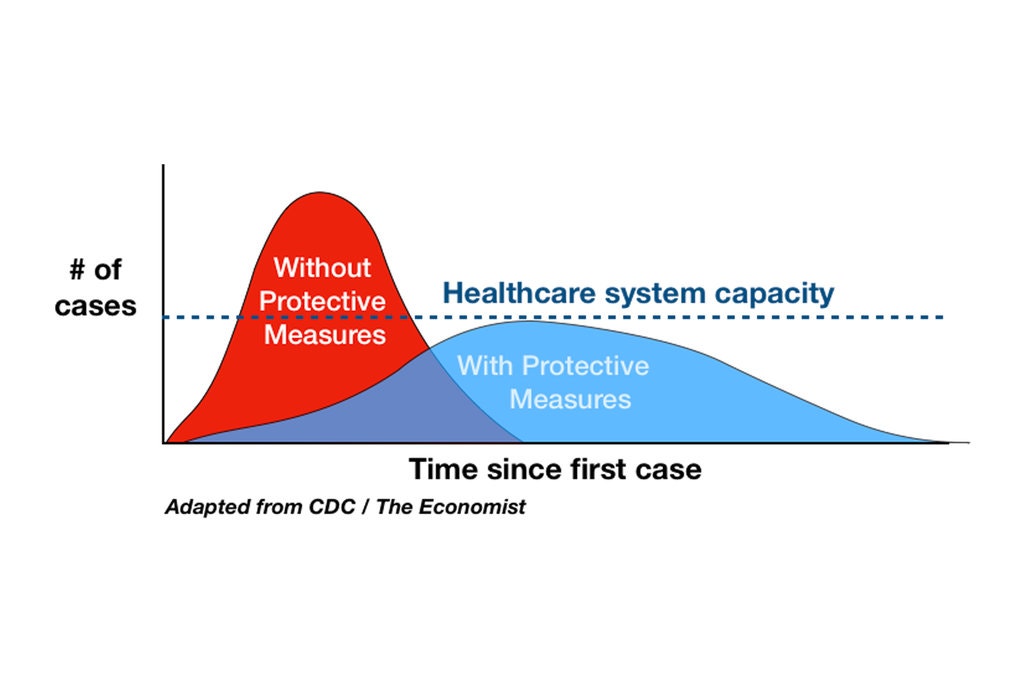
From: The New York Times
So how do we flatten the curve? You don’t need to steal masks. You don’t need to hoard toilet paper. But we do need to reduce the rate at which this disease is spreading. We need to enact strict social distancing. We don’t know who already has an incubating virus, who is an asymptomatic carrier, or who is at risk for a horrible complication. This means no large public gatherings and no unnecessary travel. It is true that everyone may get this eventually, but we need to get it slowly, one at a time, so we don’t run out of ventilators. And we absolutely cannot leave decisions about our collective health to individuals. Because we are all human, we are all grieving, and we will all take much too long to come to the safest conclusion.
Cruise ships are literally the opposite of social distancing. The CDC gently recommended that people avoid traveling on them. The cruise companies offered an on board credit if you went anyway. I’m proud that my family did the right thing and canceled our trip. But it should not have been up to us or to the cruise line. My family was just thinking about my family when they made that decision. The cruise line was just thinking about their profit margin when they offered that deal. Who is thinking about all of us?
Sean Hannity says that pandemics “happen from time to time.” There hasn’t been one in his lifetime. He’s in denial. The folks hoarding hand sanitizer and ramen noodles and the other folks lashing out at those hoarders on social media? Angry. People convincing themselves this is a disease of the elderly? Bargaining. Losing precious savings and income on a self-quarantine, canceled college classes, missed moments? Depression. Grief.
There has to be somewhere between hysteria and apathy where we can exist. We have to be able to recognize the danger of this pandemic and act swiftly and safely with limited information, but without losing trust in each other or our institutions. And that’s really difficult to do when we’re all grieving our potentially canceled trips and possibly missed concerts and endangered loved ones and awful inconveniences. If our employers force us to choose between an unpaid vacation-using self-quarantine and working while sick or possibly contagious, we will make the wrong decision. If the CDC only suggests that we skip the cruise, we’ll tell ourselves that we’ll be fine and we’ll make the wrong decision. If the concert or festival or conference does not refund your ticket or postpone, we’ll be tempted to go anyway and we’ll make the wrong decision. It should not be up to us. We’re grieving and a little scared and a little confused and we will not make the right decisions. It will take us too long to accept that this is happening. It will be too late. It might already be.
Local counties should postpone all conferences, concerts, performances, and sporting events for the time being. Everyone who can should be mandated to work from home and properly supported by their employer. All non essential travel should be halted immediately. The federal government should be supporting and funding these good decisions and not hindering them. We must act assertively. Not because we’re terrified, but because we know that our fates are linked, that we’re all in this together, that we need help trusting each other. We must be socially distant but not socially isolated. It’s difficult. But it’s the right thing to do.

 Nobody asked me...
Finding the middle ground is going to be difficult but hopefully we will prevail.
LikeLike
Well said, Antionette. (Disclaimer: she’s my cousin.) One thing about cancelling concerts, theater dates, and the like, though … I would hope that people don’t ask for refunds when they cancel. Consider that performers still have to eat, and bills need to be paid, and that it would be a Good Thing to consider your fees as donations to support the arts.
LikeLike