Things suck right now. We have this scary new disease rampaging through the world. We don’t have a vaccine or treatment or any of the modern medical marvels on which we’ve all come to rely. We waited so long to respond to this threat that it has now overwhelmed us. And scared us. And inconvenienced us. And hurt us. It sucks.
Now, after simmering inside for over a month, this fear and hurt has curdled into rage and impatience. We’re becoming toddlers tired of our time out. We’re forgetting the things we learned, we’re lashing out at people, and we’re so desperate to find a way out of our cage, that we’ll believe any explanation, make any excuse, and rationalize away any problem to escape.
Some Difficult Truths and Gentle Reminders
- COVID-19 is worse than the flu. My hospital usually has three adult ICUs, which are normally enough for all of our patients, even during flu season. We now have six adult ICUs, makeshift, staffed with volunteers. These overflow units replaced one of our pediatric floors and our entire operating suite. That has literally never happened during flu season. And this is in New Mexico, a state with one of the lowest population densities, and a nearly two month old shelter in place order. This is serious. Not just for COVID-19 patients, but for anyone who has a heart attack or ruptured aneurysm or car accident. We’re running out of room.
- We are not Sweden. I have already written a post about the challenges (not impossibilities) to this “surgical approach” for which conservative pundits continue to laud Sweden. Most articles praising Sweden forget to mention several key realities. Sweden is much smaller than the United States. It has a lower population density. It has lower rates of chronic disease. It is much more isolated in terms of borders and travel. It has a robust social safety net that predates the virus. Swedish citizens are used to working together for their common good. Swedish citizens follow the advice of experts. They have banned large gatherings. They are advising social distancing. Their case fatality rate is twice that of the United States. Sweden isn’t necessarily wrong, but anyone claiming their approach will work for everyone is misguided.
- Most people who are talking about “herd immunity” do not know what it is. Herd immunity does not mean that the herd is immune. It means that when a significant portion of the population has immunity to a disease, it stops spreading in the community and indirectly protects those who are not immune. This is usually achieved by vaccination, which prevents the disease from ever substantially replicating in its host in the first place. Herd immunity is also classically observed with diseases that result in total immunity after infection. Right now, we do not have any evidence that COVID-19 confers total immunity. We also do not have any good evidence that it doesn’t. Another example of a coronavirus is the common cold. There are many different coronaviruses that cause the common cold and although most of us have antibodies, we still get a cold or two every year. Immunity is complicated. It is not black and white. The yearly influenza vaccine, while it doesn’t always confer total immunity to that year’s flu, it usually lessens the severity of the disease. Herd immunity depends on many factors, most of which we don’t yet understand about COVID-19. Which is why no one should be making wild claims about herd immunity or reinfection or despair. And it’s why we should not be making any sudden movements in our approach to this pandemic.
People Are Trying to Fool You
You are tired. You’re frustrated. You’ve had enough. But there, waiting in the wings, are vultures. They will disguise their propaganda and lies and fear mongering under opinion pieces and web headers with the words “times” and “post.” They will sell their thoughts as sensible facts, while carefully hiding their affiliation with a partisan think tank at the very bottom of the piece. They will create bots and tweets and virtual trolls to rabble rouse and amplify their views so it seems like it’s not just them, it’s everybody.

A nationwide survey of a standard 1,022 voter sample at the end of April. Less than 20% of those surveyed thought we should relax social distancing measures.
It is not everybody. Most Americans, including most Republicans, think we are doing the right thing or even not enough when it comes to protective social measures. Only 10% of Americans doubt the effectiveness of these strategies.
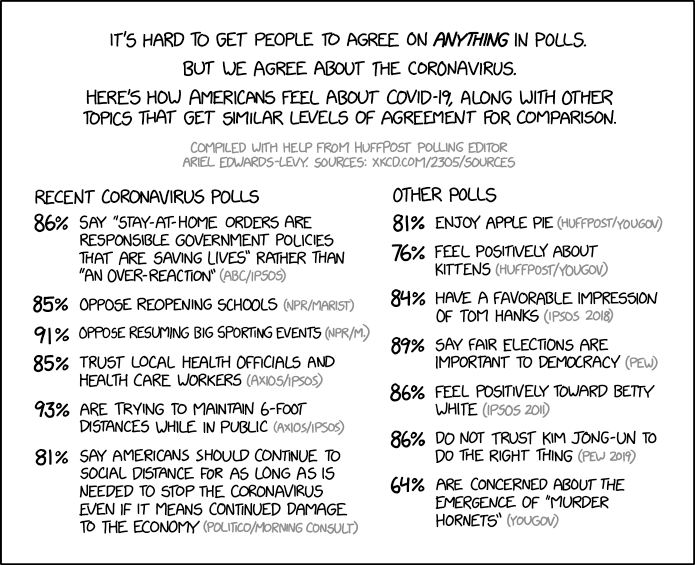
This is a comic, but there are citations!
Trusting experts is apparently more american than apple pie.
Mark Twain popularized the phrase: “There are three kinds of lies: lies, damned lies, and statistics.” He’s right about the numbers. Spin can turn any number into evidence for any case. We need to be careful and thoughtful about the things we read. Is the person writing the article an epidemiologist or a virologist or a doctor? They probably have useful things to say, but not always. Do they work for a partisan publication or think tank? This is usually hidden at the bottom of an article, by the author’s name, or not displayed at all, but is certainly a good indicator of bias. Are they speaking in absolutes and certainties? We do not know enough to speak in absolutes and certainties. Be wary of this confidence. It is usually hiding inadequacy.
Let’s use our difficult truths as examples. I’ve seen several articles arguing for immediate and total reopening that assert that COVID-19 is no worse than the flu. Sometimes they cherry pick statistics to bolster their point, sometimes they just declare it to be so. Either way, it isn’t true. But it sure makes their argument more convincing to someone skimming the article. The same goes for the pieces about Sweden and herd immunity. The complexity of these issues and the grand sweeping uncertainty is always left out. The authors may be unintentionally obtuse or purposefully misleading, but always doubt a claim that has no downsides and no complications.
Spreading misinformation is harmful and the only people who gain are politicians, foreign governments, and corporations. They just want your vote, your country, and your money. Don’t let them have it. Don’t let them divide us. We’re all on the same team.
We Are Trying to Fool Ourselves
The irrational thinking and information threats aren’t just external. The longer you stay cooped up, worried, and isolated from your community, the easier it becomes to adopt any explanation that will permit your escape. I’m tempted to do it all the time. I want to be able to travel and go to my favorite bars and hang out with my friends. Thankfully there’s nothing like an overnight shift in our overflow ICU, managing ventilators, talking to grieving families, to remind me why we’re doing this.
I have already written about how easy it was to tell myself that COVID-19 was no big deal. It was less scary and way more convenient to believe that. Our minds are designed to do this. Daniel Kahneman explains some of these phenomena with a “fast brain,” or System 1, and a “slow brain,” or System 2. System 1 is fast, intuitive, quick, and a gut reflex. It’s the one that enables our routines and habits. System 2 is slow, patient, and analytical. It’s the one that can solve riddles. Your slow brain is the one you need to overcome the cognitive biases of your fast brain.
These cognitive biases are innate and universal in human psychology. They have lots of fancy names but are all rooted in the same place: our brain will try to come up with an explanation as quickly as possible, relying on shortcuts, learned behaviors, and our emotional motivations. We overlook things, we become fixated on things, and we misinterpret things.
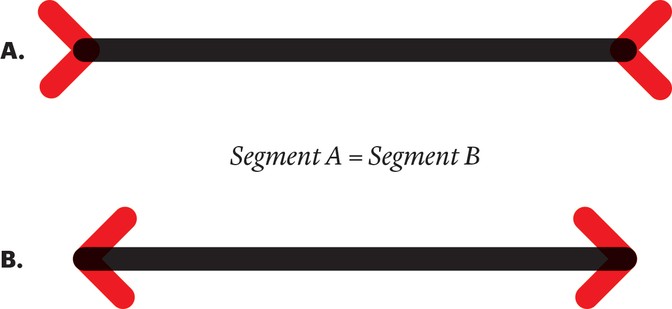
You’ve probably seen this before. These lines are the same length, but they don’t look it. Once you know the truth, System 2, the slow analytical mind, will convince you not to trust the quick reflex of System 1. But we will still see the lines as different lengths even if we know they are not. Imagine how much harder it is to use System 2 in the real world when System 1 is just so convincing. “Unfortunately, this sensible procedure is least likely to be applied when it is needed most,” Kahneman writes. “We would all like to have a warning bell that rings loudly whenever we are about to make a serious error, but no such bell is available.”
If you are desperate to find a reason to leave your home, you will overlook the author’s affiliation with a conservative think tank. You will fixate on the positive arguments supporting your deepest desires and miss the big picture. You will misinterpret statistics and make excuses for their existence. You will fool yourself.
If you are desperate to go to a party and see your friends, your brain and heart will leap joyously at information that supports that prospect. You will forget the small details like death tolls and missing data and claim that herd immunity is the best and only solution. You will breeze past the fact that you don’t truly understand herd immunity or that plenty of people who do have posed valid concerns about it as a solitary solution. You will gravitate to convincing community centered arguments for why it’s best to open up quickly and completely. You will not listen to rebuttals. You will ignore your System 2. Because your System 1 wants to go to a party.
I think some of us have bad intentions. But I think many more of us do not. It’s okay to want to go to a party. I want to see my friends too. And the people writing these articles are vulnerable to the same cognitive biases you and I are. The intention is not to place blame, but to hold ourselves accountable for what we read and say and believe. Take the time to check sources. When confronted with information you don’t like, information that makes you angry, take a deep breath and read it again. Seek first to understand before you seek to challenge. But when you decide to challenge, do so thoughtfully and respectfully, with space for uncertainty and new information.
This weekend, several people I respect and care about posted articles from partisan sources with flawed arguments for opening up quickly and completely. When I first read them I was angry. I was tired and had just worked an overnight shift and my brain was in fast paced, instinct mode. I stomped around my apartment seething. But I used my strategies. I took a deep breath. I read the articles again. I checked their sources. I learned a bunch of things. I managed to write what I hope is an empathetic and helpful blog post instead of an enraged and useless one. I’m still mad, but I made sure my thoughtful, slow brain won.
Where Do We Go From Here
We could have done better. We could have used the lead we had on the virus to increase healthcare infrastructure, to design testing and mitigation plans, and to establish a relief package for unemployment. But we didn’t. It would be easy to blame that solely on the duds in the Capitol Building or the dud in chief in the White House. While they certainly bear some of the blame, it’s not that simple. Turning the virus and our response into a political disagreement undermines the work everyone has been doing to keep each other safe and healthy and alive. It undermines the need for collective action. It undermines the truth that this is a terribly difficult problem that takes a diverse team to solve.
Remember, most people agree that lifting restrictions as soon as possible makes sense. You have local health officials who are closely monitoring your local hospital capacity, your local infection rate, your local fatality rate, and your local economic situation. Trust those people. Try to do what they say even when it’s hard. Take these economic ramifications seriously. Be generous when you can. Remember that your actions have consequences. Even if your local government throws caution to the wind, you don’t have to. You can still wear a mask. You can still have safe gatherings. You can still order take out.
The story of two opposing sides, where one wants us to bunker down for two years and one wants us to open as quickly and completely as possible, is a myth. Almost everyone is in the middle. We may disagree about where exactly the middle is, but we’re all on the same team. Slowly easing restrictions as soon as possible is the plan everywhere – once communities have testing capacity, adequate healthcare infrastructure, a proper social support system, and plans for safe community interaction. We have to stop fighting each other about it. We are all on the same team. We’re all in the same storm.
This is how we fight the virus, each in our own way. I keep going to work every day to take care of patients. The postal workers keep delivering mail. Small business owners keep innovating safe new business models. We keep sharing what we have to spare. We keep thinking critically and carefully about what we read and say and believe. And everyone keeps calm and courageous. We fight the virus with trust. With patience. Not with anger and resentment and selfishness. We fight the virus together.


 Nobody asked me...
Another informative and well written post. So proud of you ❤️
LikeLike
Well said, Antoinette.
LikeLike
What a wonderful, thoughtful, insightful and well written article.
Thank you.
I’m so very PROUD of YOU!!
LikeLike